How to Improve Endurance for 15-Inch FPV Platforms: Motors, ESCs and Flight Controller Matching

“I need a customised 15-inch FPV platform with longer flight time. Can we simply reduce the payload or use a larger battery?”
This is a common question in larger FPV and UAV builds. On the surface, endurance optimisation sounds simple: use a bigger battery, reduce some weight, and the aircraft should fly longer.
In practice, it is not that straightforward.
For larger FPV platforms, endurance is not decided by battery capacity alone. It depends on how the full hardware system works together: motors, ESCs, power distribution, flight controller tuning, payload layout and installation quality.
JetLancer AI provides flight controllers, ESCs, PDBs and related drone components for UAV developers, system integrators, OEM partners and FPV platform builders. Our role is not to claim that one component solves every endurance problem. The real value is helping customers choose and match the right electronics for the platform they are building.
Common Misunderstandings About Endurance
Misunderstanding One: A Larger Battery Always Means Longer Flight Time
For a 15-inch FPV platform, a larger battery is not always the best answer.
A bigger battery increases total aircraft weight. As the aircraft becomes heavier, the motors need to produce more thrust to keep it in the air. That extra thrust requires more current, which can reduce the benefit of the additional battery capacity.
A larger battery can also change the centre of gravity. If the platform becomes unbalanced, the flight controller has to make more frequent attitude corrections. These corrections consume energy and may reduce flight stability.
In some cases, an oversized battery can also affect manoeuvrability or exceed the practical load range of the airframe.
Misunderstanding Two: Reducing Payload Is Always the Best Solution
Reducing weight can help, but it has to be done carefully.
Custom FPV and UAV platforms often carry cameras, video transmission equipment, telemetry modules, vision modules or other task-related payloads. These are not decorative parts. They are part of the platform’s purpose.
Removing necessary equipment may reduce weight slightly, but it can also weaken the function of the aircraft. For a 15-inch build, the airframe, motors, propellers and battery already account for a large part of the weight, so simple weight reduction often gives limited results.
A better approach is targeted weight optimisation: remove redundant parts, use lighter materials where appropriate, improve wiring and payload layout, and keep the centre of gravity balanced.
Endurance Comes from System Matching
For larger FPV and UAV platforms, endurance should be treated as a system-level issue.
A simple comparison is a heavy-duty vehicle:
- The battery is the fuel tank
- The motors are the engine
- The ESCs are the transmission system
- The PDB is the power distribution backbone
- The flight controller is the driver
- Telemetry, video transmission or data-link modules are communication channels
A larger fuel tank will not help much if the engine is inefficient, the transmission is poorly matched, the power path is unstable, or the driver keeps overcorrecting.
With similar battery capacity, two 15-inch FPV platforms can have very different flight times. The difference often comes from motor selection, ESC matching, power distribution, flight controller tuning and the overall installation layout.
Four Practical Areas to Check
1. Motor Selection
Motor selection has a direct impact on endurance.
A common mistake is using high-KV racing motors on a larger FPV platform. These motors can provide strong acceleration, but they may consume more power and generate more heat when used with larger propellers or heavier payloads.
For endurance-focused 15-inch platforms, motor selection should be based on voltage, propeller size, payload and flight style. In many cases, lower-KV, high-torque and high-efficiency motors are more suitable than high-KV racing motors.
Recommended direction:
- Select motor KV according to voltage and propeller size
- Prioritise torque for larger propellers and heavier payloads
- Avoid unnecessary heat and power loss
- Match motor output with the real payload and flight requirement
- Keep thrust distribution balanced across the platform
JetLancer AI does not position this as a motor-only issue. Motor choice needs to be considered together with ESC capacity, flight controller behaviour and power distribution.
2. ESC and Power Distribution Matching
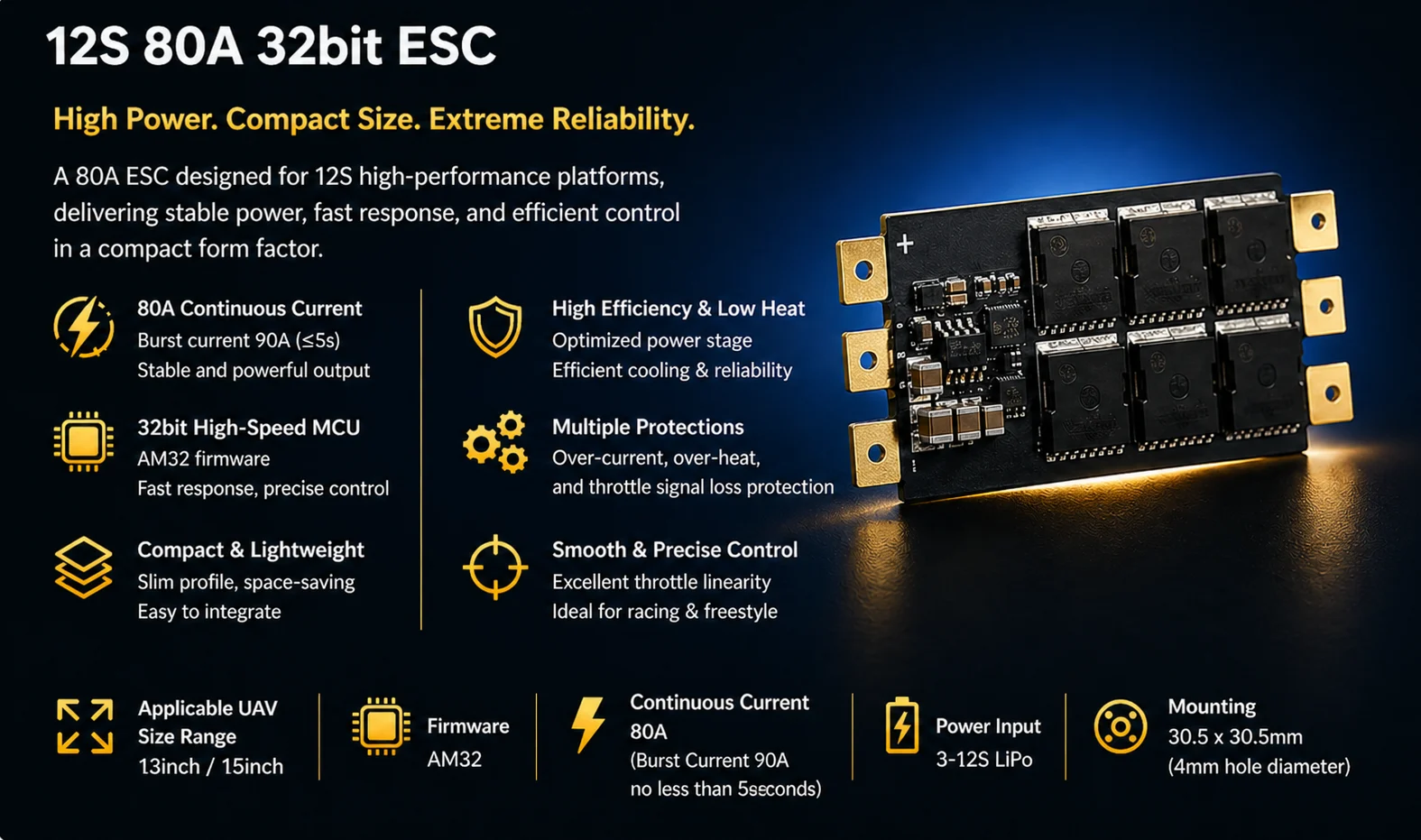
The ESC determines how efficiently battery power is delivered to the motors. Poor ESC matching can lead to heat, unstable output, poor throttle response and unnecessary power loss.
For larger FPV platforms, ESC selection should consider motor power, propeller size, battery voltage, current demand and expected load.
Recommended direction:
- Use efficient ESCs with suitable current margin
- Match ESC specifications with the motor and propeller combination
- Calibrate throttle response properly
- Pay attention to heat dissipation
- Keep wiring clean and reliable
JetLancer AI’s current ESC product line includes options listed for larger 13-inch and 15-inch UAV builds, including 12S 80A ESC solutions.
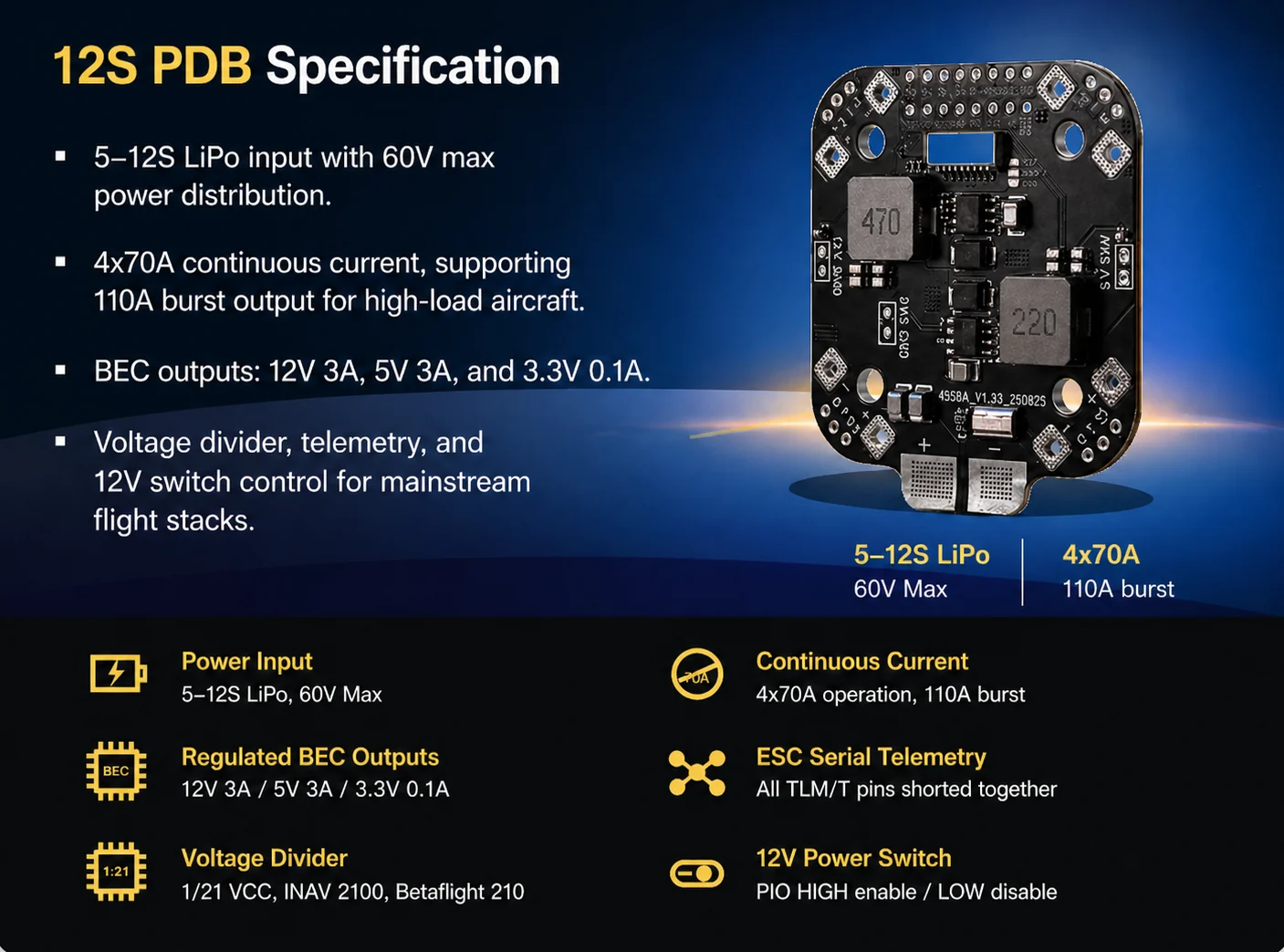
Power distribution should be treated separately and accurately. A PDB should not be described only by aircraft size. It should be selected according to voltage, current, wiring layout and power requirements.
JetLancer AI provides PDB solutions for high-voltage power distribution, including 5-12S LiPo input and 60V max power distribution specifications. This makes the PDB part of the electrical system planning, rather than a simple “15-inch platform” label.
3. Flight Controller Selection and Tuning
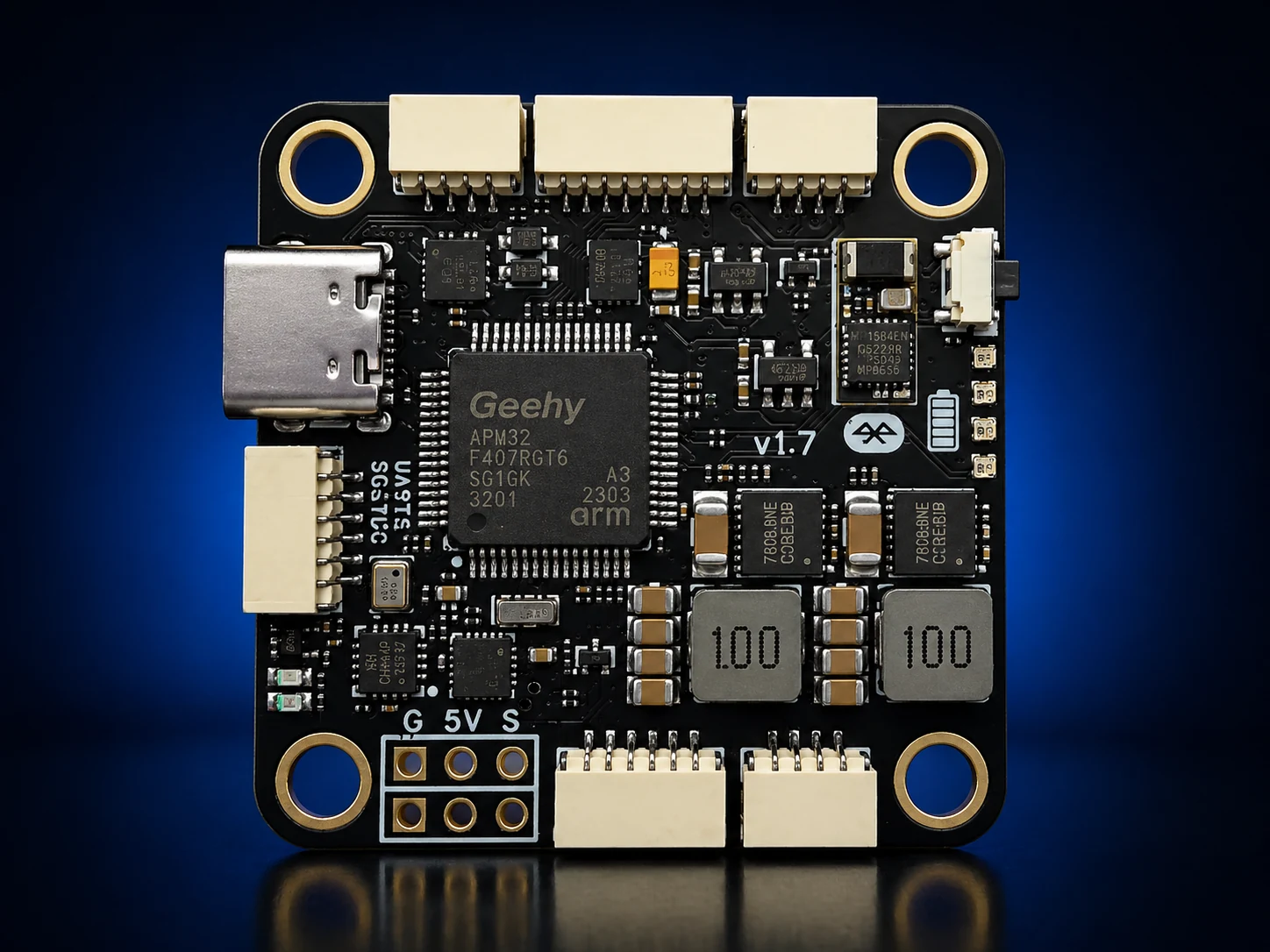
The flight controller affects how often the aircraft corrects its attitude, how smoothly it responds to disturbance, and how efficiently it maintains stable flight.
With the same hardware, poor tuning can waste energy through constant correction, vibration and unstable control response.
Key tuning areas include:
- Reducing excessive attitude sensitivity
- Optimising stabilisation PID parameters
- Adjusting filters to reduce high-frequency motor vibration
- Avoiding unnecessary drift correction
- Limiting aggressive throttle behaviour during endurance-focused cruising
- Keeping manoeuvre angles reasonable for the use case
JetLancer AI provides flight controller hardware for FPV, fixed-wing, industrial UAV and customised drone platforms. Current flight controller products cover compact FPV builds as well as larger UAV applications, including 5-15 inch or 7-15 inch platform ranges depending on the model.
This means flight controller choice should be based on the actual airframe, firmware requirements, interface needs and installation space.
4. Battery, Payload and Communication Layout
Battery and payload still matter, but they should support the hardware system rather than compensate for poor matching.
For payload layout:
- Remove redundant accessories
- Keep mission-critical equipment
- Use lightweight structure where appropriate
- Keep the centre of gravity balanced
- Plan clean wiring and installation space
For battery selection:
- Choose capacity according to airframe and payload
- Prioritise low internal resistance and good energy density
- Avoid blindly increasing capacity
- Inspect and maintain batteries regularly
- Replace ageing batteries before they reduce system efficiency
For platforms that may later require telemetry, video transmission or data-link modules, it is sensible to reserve power supply, mounting space and interface layout during the early design stage.
This does not mean every platform needs a data-link module immediately. It simply avoids rebuilding the whole platform later when communication hardware is added.
Practical Endurance Checklist
For customers building larger FPV or UAV platforms, the following checklist is a useful starting point:
- Motors — Select motors according to voltage, propeller size, payload and flight style. Avoid choosing only by peak power.
- ESCs — Use ESCs with suitable current margin and good thermal performance. Match them with the motor and propeller combination.
- Power Distribution — Choose a PDB or power distribution solution according to voltage, current and wiring layout, not only by aircraft size.
- Flight Controller — Choose a flight controller suitable for the airframe size, firmware requirement and interface layout. Tune PID and filters according to the platform.
- Payload Layout — Remove unnecessary parts, keep required equipment and maintain a balanced centre of gravity.
- Battery — Select a battery that fits the platform’s real power demand. Bigger is not always better.
- Communication Preparation — If telemetry, video transmission or future data-link modules may be required, reserve suitable power, space and interface access from the beginning.
JetLancer AI Product Support
JetLancer AI provides flight controllers, ESCs, PDBs and related drone components for UAV developers, system integrators, OEM partners and FPV platform builders.
For larger FPV and UAV platforms, our support focuses on practical component matching:
- selecting suitable flight controllers for the airframe
- matching ESC specifications with motor and propeller requirements
- choosing PDBs according to voltage and power distribution needs
- helping customers plan wiring, payload layout and installation space
- supporting OEM customers with component supply and integration requirements
As customer projects become more complex, telemetry, video transmission and data-link modules are increasingly considered during early platform planning. JetLancer AI is paying close attention to these integration requirements, especially power supply, interface layout and installation space around the flight controller, ESC and power distribution system. This helps customers leave room for future communication hardware without making any product assumptions too early.
This is practical work, not a slogan. A cleaner layout, better-matched electronics and enough installation margin can save time during assembly, testing and later upgrades.
JetLancer AI does not treat endurance as a simple battery problem. For larger FPV and UAV platforms, endurance depends on matched electronics: flight controllers, ESCs, power distribution, payload layout and installation planning.
Expected Results
With proper optimisation, a larger FPV platform can achieve more stable and efficient flight without removing core equipment or weakening the platform’s main function.
The exact improvement depends on the airframe, propellers, motors, ESCs, battery, payload, flying style and tuning quality. In real projects, even small improvements in motor matching, ESC selection, power distribution and flight controller tuning can add up.
If you are building a 15-inch FPV platform or developing a custom UAV, JetLancer AI can support your project with product selection, hardware supply and OEM integration planning.
Interested in AI FC Integration?
Contact us for OEM pricing and technical documentation.
Get in Touch