Starlink Jamming: Eight Clear Questions, Without the Hype
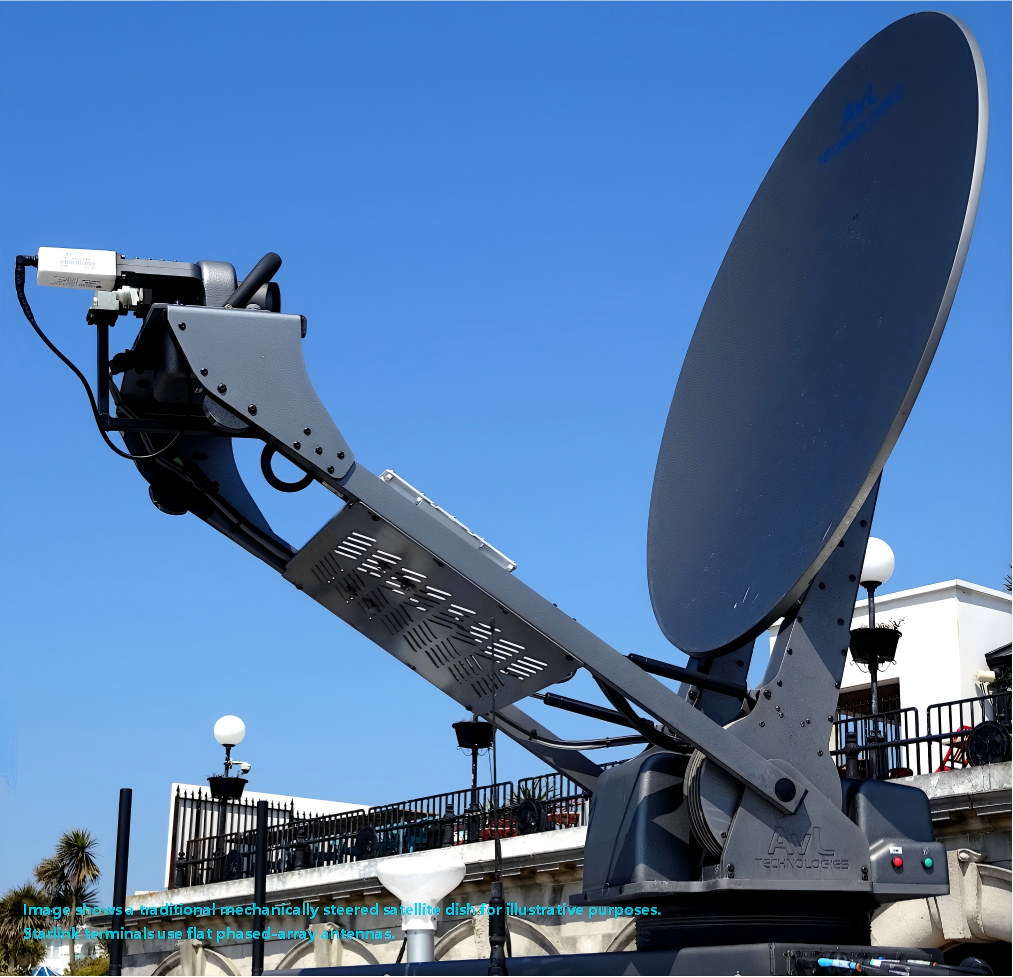
Public technical explainer only. Knowing the principle does not mean it can be done in practice.
If you talk to people in the trade, or spend any time scrolling short videos, you will have seen the claims. One says a high-power box pointed at the sky can bring Starlink down completely. Another says Starlink’s phased array is untouchable. Both are wide of the mark. Here are the eight questions I hear most, answered in plain language. I have kept the maths out of it.
Q1: What is Starlink jamming? Are we trying to damage the satellites?
No. It is soft suppression, not physical damage. Imagine two people talking. Jamming is not taping their mouths shut. It is standing next to them with a loudhailer, drowning out the conversation. Starlink is a radio conversation. Jamming puts noise in the same band, burying the wanted signal so the receiver cannot make out the data. The satellite is untouched. Turn the jammer off and the link will probably come back.
Q2: What are uplink and downlink jamming, and why are they so different?
This is where a lot of explanations get vague. Downlink is satellite to ground terminal, in the 10.7–12.7 GHz range. Downlink jamming aims at the terminal’s receiver. Uplink is ground terminal to satellite, in the 14.0–14.5 GHz range. Uplink jamming aims at the satellite’s receiver hundreds of kilometres up.
Put it this way: downlink jamming is someone shouting in your ear while you try to listen to someone else. Uplink jamming is you standing on the ground, shouting upwards, trying to stop a satellite 550 km away from hearing a faint signal from a terminal. The distances are not comparable. Downlink has the lower physical barrier. Uplink has to overcome hundreds of kilometres of path loss, so the hardware costs far more. Both are jamming. They are not the same job.
Q3: If downlink is easier, can any high-power device nearby take out Starlink?
Not quite. The Starlink terminal is not an ordinary dish. It is a phased-array antenna. It steers its beam upwards towards the satellite and suppresses interference coming in from the side. This is often called null steering. Raw power alone is not enough. The array will try to filter out ground-level noise.
That said, it is not invincible. If the interfering signal is strong enough, it can get in through the sidelobes and saturate the LNB front end. The terminal then stops working. So downlink jamming has a lower theoretical barrier, but the terminal fights back. It is not a guaranteed hit.
Q4: Is GPS jamming the same as Starlink jamming?
No. This is a common trap for people from electronic warfare. GPS is a one-way broadcast. The satellite only transmits. The terminal only receives. So GPS jamming is aimed at the ground receiver. Starlink is two-way. It has separate uplink and downlink paths, and the satellite also has to receive data from the ground.
GPS satellites are higher, and their signals arrive much weaker. Starlink uses Ku-band, with wider bandwidth, a phased array, and fast satellite handovers. The countermeasure logic is much more complicated. Do not simply copy across GPS experience.
Q5: If a drone carries a Starlink terminal, will jamming make it crash?
This is the low-altitude security scenario people ask about most. The key mistake is assuming the two links fail together. They are independent. Jam the downlink and the terminal may not receive commands from the satellite, but it may still transmit. Jam the uplink and it may not send video or status data, but it may still receive commands. You do not get a clean, instant, two-way cut.
Then add a drone in the air, a Starlink terminal moving with it, and a satellite that passes out of view in minutes. The problem gets harder again. The idea of one jammer bringing a drone down on the spot does not match the physics.
Q6: The Starlink phased array is supposed to be strong. Is it completely immune?
No. A phased array is impressive. It can steer its beam and place a null in the direction of an interferer. But it is not a suit of armour. First, it can only form a limited number of nulls. Several interferers from different directions will stretch it. Second, if the interfering energy is high enough to saturate the receiver front end, no clever algorithm can rescue the signal. Third, satellite firmware can be updated with new anti-jamming tactics, and jamming equipment then has to keep up. It is a cat-and-mouse game. The phased array raises the bar. It does not make jamming impossible.
Q7: Is it hard to detect Starlink signals? Can an ordinary spectrum analyser do it?
Many people think you can point a spectrum analyser at the sky and pick up Starlink easily. Two problems get in the way. First, Starlink is a low-Earth-orbit constellation. Satellites cross overhead in minutes. If the antenna cannot track them, the opportunity is gone almost as soon as it appears. Second, Starlink does not sit on one fixed frequency. It uses frequency agility and hopping. You may see energy across a band, but separating one terminal’s signal from the rest is much harder.
An ordinary spectrum analyser can show that something is transmitting in the band. Locating it, isolating one terminal, and doing anything specific about it is a much bigger hardware problem.
Q8: Can the “Starlink killer” equipment advertised online take out Starlink everywhere?
Public reports of Starlink countermeasures need one important caveat. They are almost always local suppression, not global or wide-area blackout. One system can create a “signal black hole” over a limited area. Outside that area, Starlink carries on.
Meanwhile, thousands of satellites are passing overhead. Even if one link is suppressed, the next satellite may soon take over. To blank out a large area, you need multiple systems working together, with the cost and hardware scale that implies. There is no sci-fi scenario where one box is switched on and a whole country’s Starlink goes dark.
The short version
Starlink countermeasures are a game of physics, hardware and iteration. Short videos often reduce it to “point a big loudspeaker at the sky”, which creates a false picture. The physical gap between uplink and downlink, the limits of a phased array, and the speed of low-Earth-orbit satellites all change the outcome. It is worth studying. It is also worth knowing where paper exercises end and engineering reality begins.
This article is a public technical explainer only. Understanding the principles is not permission or instruction to attempt anything in the field.
Interested in AI FC Integration?
Contact us for OEM pricing and technical documentation.
Get in Touch