Stop Comparing FPV Kits to AI Flight Control Platforms
Traditional FPV drones are built around the pilot. The pilot sees, decides, adjusts, and corrects in real time. The flight controller mainly stabilizes the aircraft and translates human input into motion.
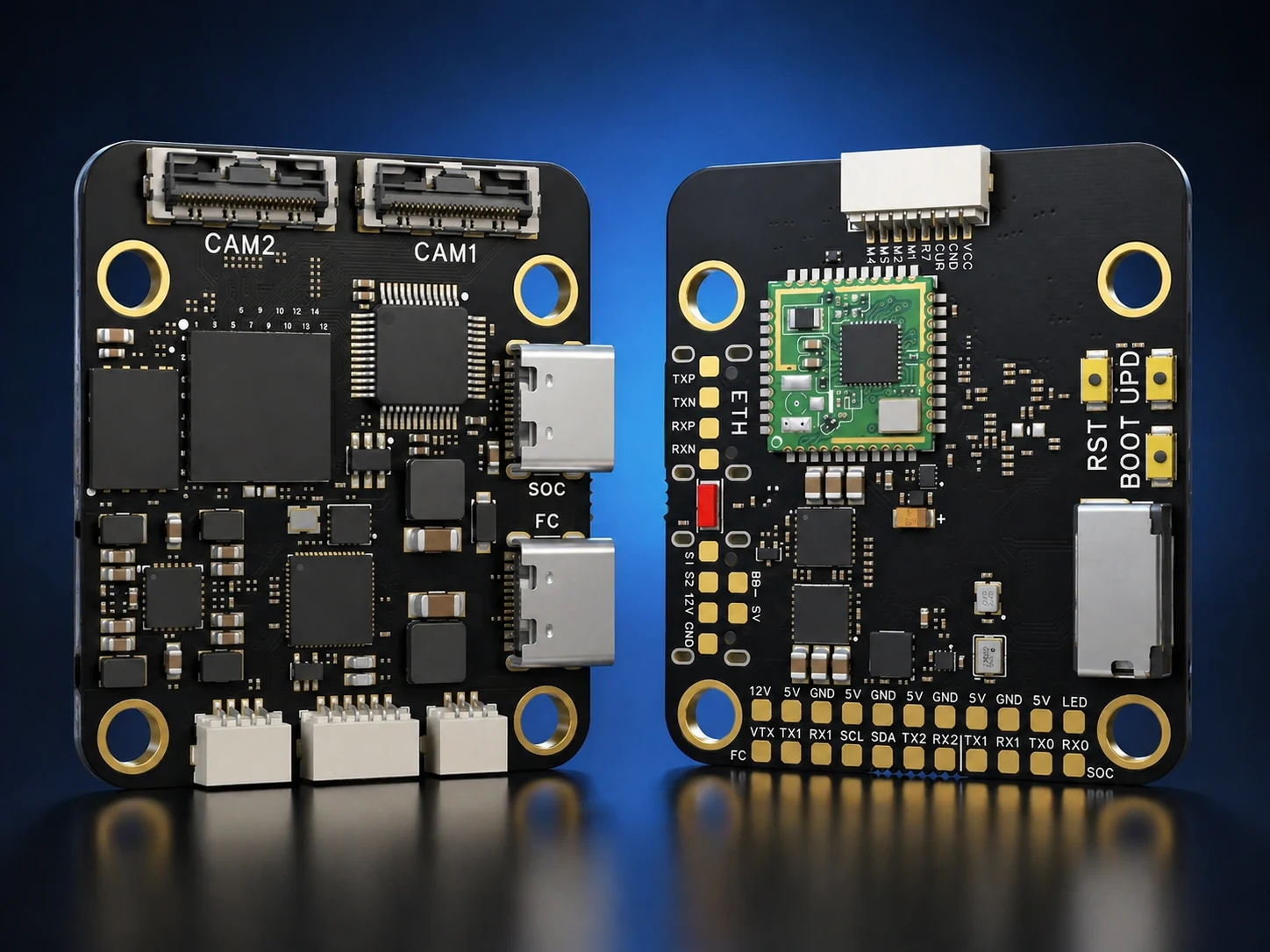
The JetLancer AI system takes a different approach — integrating AI perception, sensor data, and flight control logic into a smarter control architecture for advanced drone applications.
Why FPV and AI Flight Control Are Different
At first glance, FPV platforms and AI flight control platforms may appear similar. They may use familiar components, similar frame sizes, and even comparable controller chips.
But the system logic is different.
FPV is built for manual control, racing, freestyle, and pilot experience. An AI flight control platform is built around real-time data processing, adaptive response, motion prediction, and stable execution under changing flight conditions.
The difference is not only the hardware appearance. The difference is the control architecture.
Deep AI and Flight Controller Integration
In a conventional FPV setup, the human pilot is the decision maker. The flight controller stabilizes the aircraft and follows stick input.
In the JetLancer AI architecture, the AI module does more than provide external data. It works with the flight controller to analyze motion, understand flight conditions, and support real-time control decisions.
At the same time, the flight controller provides attitude, speed, altitude, sensor status, and system feedback to the AI module. This creates a closed-loop control system where perception and flight control continuously adjust to each other.
This is not simple command passing. It is deep integration between intelligence and flight control.
Built for Drone Manufacturers and System Integrators
For OEM drone manufacturers, developers, and system integrators, AI flight control opens new possibilities beyond traditional FPV platforms:
- Closed-loop control — AI data and flight control feedback work together in real time
- Adaptive tuning — the controller can better adapt to different airframes and payload conditions
- Motion prediction — the system responds to changing flight dynamics instead of relying only on fixed parameters
- Environmental adaptation — control logic adjusts to wind, vibration, battery state, and load changes
- Reliable integration — hardware, firmware, and interfaces are designed for product-level development
Same Chip, Different System
Many FPV and industrial flight controllers may use similar processors, such as F405 or F722-class chips. But the processor is only one part of the system.
For JetLancer AI, the key differences are firmware architecture, sensor fusion, scheduling priority, interface logic, safety handling, and AI-control synchronization.
An FPV controller is optimized for pilot feel. A JetLancer AI flight controller is optimized for intelligent control, integration flexibility, and reliable operation.
Power, ESC, and Actuation Requirements
FPV power systems often focus on burst acceleration, speed, and aggressive handling. That is suitable for racing and freestyle.
AI flight control platforms require a different balance. The control system must prioritize smooth command response, stable power delivery, accurate sensor feedback, and predictable attitude control.
This is why ESC selection, motor response, power curves, and tuning logic cannot simply be copied from FPV builds. Similar components do not always mean similar engineering requirements.
Video Is Not the Core Control Loop
In FPV, video transmission is central. The pilot depends on the video feed to fly.
In an AI-assisted platform, video may support observation, monitoring, or data collection. But the control loop depends on onboard sensors, flight controller feedback, and intelligent control logic.
This distinction is important. A reliable drone platform should continue making stable control decisions even when external video quality changes.
From FPV Experience to Intelligent Flight Control
The core of FPV is human-machine experience. The core of JetLancer AI is intelligent flight control integration.
The two may look similar from the outside, but they are designed for different objectives, different reliability standards, and different development requirements.
JetLancer AI provides flight controllers and drone components for OEM partners, developers, and system integrators who need more than standard FPV hardware.
Contact JetLancer AI to discuss flight controller integration, hardware documentation, firmware support, and OEM cooperation.
Interested in AI FC Integration?
Contact us for OEM pricing and technical documentation.
Get in Touch