Direct Answer
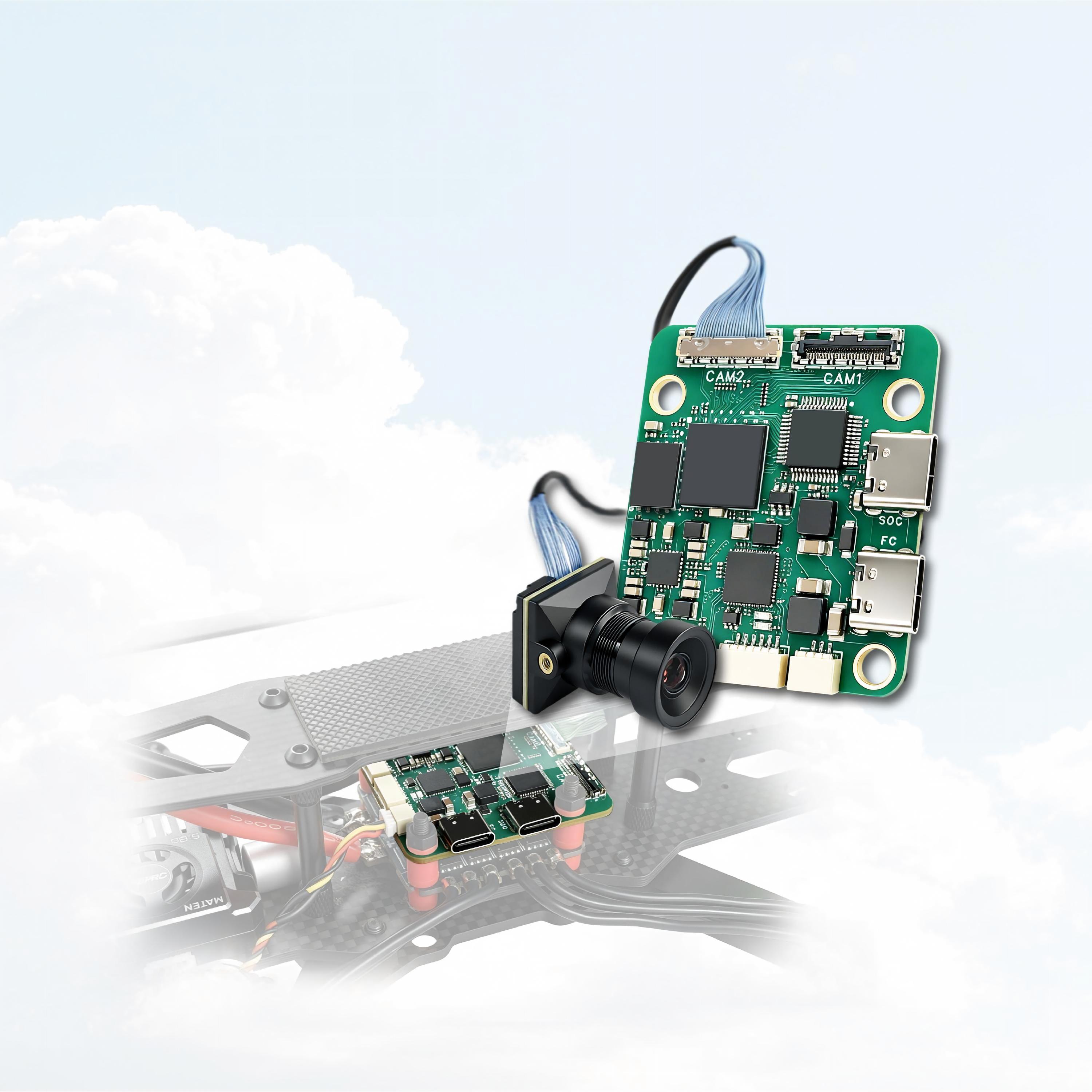
An AI flight controller combines a standard flight-control loop with an onboard neural processing unit (NPU). It processes camera and sensor data in real time, allowing autonomous tracking and obstacle avoidance without needing a separate companion computer.
How it works
A standard flight controller relies on an IMU to stabilise the aircraft based on radio commands. An AI flight controller inserts a vision processor directly into that loop:
Camera + IMU → Vision AI Processor → Flight-Control Loop → ESC Output
Recent research shows that vision-only flight control is already practical using low-latency neural networks. A lightweight recurrent convolutional network (ConvRNN) can replace the IMU entirely, estimating both attitude and rotation rates on the fly(Nature,2026).This matters because it cuts out the cable, weight, and latency penalties that come with traditional companion computers.
Modern AI FCs pack a real-time microcontroller (often an ARM Cortex-M7) alongside application cores and an NPU in a single form factor. This lets you run Betaflight and accelerate object detection, sensor fusion, and obstacle avoidance on the same board(IEEE,2025).
This setup is most useful in GNSS-denied environments or signal blind spots. If the radio link drops, the onboard AI takes over, locks onto a target, and completes the mission autonomously. Lightweight tracking algorithms now make real-time pursuit possible using only the onboard camera(Malarchick, R., Castelblanco, J., Amaya, E., DiMario, C., Brinkman, G., Kumar, C., Yoon, K., & Berhane, S,2025).
AI FC vs Standard FC
| Feature | Standard Flight Controller | AI Flight Controller |
|---|---|---|
| Core Processing | MCU (e.g., F405/F722) | MCU + NPU |
| Companion Computer | Usually required for AI tasks | Not required |
| Weight | FC + companion (heavy) | Highly integrated (down to 10g) |
| Power | Higher (companion draws 2–5× more) | Ultra-low (down to 2W) |
| Autonomous Tracking | No (needs ground control) | Yes (onboard forced lock) |
| Latency | Higher (physical cable link) | Lower (on-chip integration) |
Traditional companion computers designed for image processing often draw 2–5 times the power and weigh almost double a standard FC. Sticking the NPU directly on the flight controller removes that overhead(Okudera, R., Li, Y., Matsubara, Y., & Takada, H,2025).
JetLancer AI FC
The JetLancer AI+Betaflight 2-in-1 FC puts this architecture to work. It suits 5–18 inch quadcopters, runs 4S–8S LiPo, and runs Betaflight natively.
- Camera: Built-in 1080P digital camera (4mm lens, 60FPS, 96° FOV).
- AI Performance: Starlight night vision; locks onto vehicles at 450m and personnel at 150m; 20×20 minimum tracking pixel; tracks targets moving faster than 80km/h.
- Interfaces: CVBS analogue video, ELRS (CRSF), DSHOT 300/600, plus 2× PWM servo outputs.
- Operation: Flip CH10 to engage forced lock. The drone then tracks and engages moving or fixed targets on its own.
- Firmware: Native Betaflight support, no extra FC needed.
Limitations
Onboard AI vision still has limits. Performance drops in low-texture environments or heavy weather where contrast is poor. CVBS compatibility keeps things simple, but it caps the resolution available to the NPU compared to pure digital feeds. Also, cramming an NPU into a standard FC form factor creates thermal and power trade-offs you have to manage during sustained operation.
Want to see how this architecture performs in practice?
Request the JetLancer AI FC datasheet to review full specifications, or contact our engineering team to discuss your OEM integration requirements.
References
[1] Nature. (2026). Vision-only flight control promises lighter flying systems. npj Robotics. https://www.nature.com/articles/s44182-026-00081-4
[2] IEEE. (2025). High Performance Autonomous Target Tracking and Control Method for Quadrotors Using Artificial Intelligence. IEEE Access, 13, 214236–214252. https://ieeexplore.ieee.org/document/11278611
[3] Malarchick, R., Castelblanco, J., Amaya, E., DiMario, C., Brinkman, G., Kumar, C., Yoon, K., & Berhane, S. (2025). Robust Real-Time UAV Target Tracking with Onboard Vision-Based Yaw Control. Beyond: Undergraduate Research Journal, 9, Article 6. https://commons.erau.edu/beyond/vol9/iss1/6
[4] Okudera, R., Li, Y., Matsubara, Y., & Takada, H. (2025). A COTS-based Lightweight, Low-power and Versatile Companion Computer for Nano UAVs. Sensors & Transducers, 265(3), 3359. https://sensorsportal.com/HTML/ST_JOURNAL/PDF_Files/p_3359.pdf