Why Data Links Are Becoming Essential in Modern FPV Flight Stacks
.webp)
FPV drones are no longer judged only by motor power, propeller choice and flight-controller tuning. As FPV and UAV platforms become more advanced, builders are paying closer attention to telemetry, data transmission, ground connectivity and multi-node communication.
This trend is becoming more visible across the wider drone industry. BVLOS discussions, ground-control workflows, MAVLink telemetry and connected flight-stack design all point in the same direction: communication hardware is becoming part of the core build, not just an optional accessory.
For JetLancer AI, this fits naturally with the company’s FPV component direction: AI FC, standard flight controllers, ESCs, PDBs and data-link hardware designed to support cleaner system integration.
From Flight Control to Connected Flight Stacks
A traditional FPV build usually focuses on the flight controller, ESC, receiver, video system and power distribution. These parts still matter, but modern builds increasingly need to move data between the aircraft, ground station and other connected nodes.
That data may include telemetry, status feedback, video-related information, control data, network information or development-level test data. For FPV builders and OEM customers, this means the flight stack needs more than stable control. It also needs reliable communication planning.
The flight controller, receiver, data link, ESC and PDB should be considered together. If communication hardware is added too late, the final build may face wiring pressure, power limitations, antenna placement issues or difficult maintenance.
Introducing JetLancer DL M2 (010)
JetLancer AI has officially launched DL M2 (010), a video-data integrated self-forming mesh networking product for FPV and UAV hardware integration.
According to the product manual, DL M2 (010) uses a software-defined radio design with a private OFDM waveform. It supports real-time interference scanning and adaptive intelligent frequency selection. It also supports chain networking, mesh networking and hybrid networking, with dynamic routing for multi-node mobile scenarios.
Key specifications listed in the manual include:
- 1350-1450 MHz working frequency range
- QPSK / 16-QAM adaptive modulation
- 5 / 10 / 20 MHz bandwidth configuration
- 2 x 30 dBm transmit power
- 30 km specified communication distance
- 40 Mbps wireless rate
- Latency of no more than 15 ms
- Up to 64 nodes in a single subnet
- Up to 16-hop transmission
- TTL, RS232 and 10/100 Mbps Ethernet interfaces
- DC 18-28 V power input
- 96.5 mm x 85.5 mm x 16 mm body size
- 215 g main unit weight
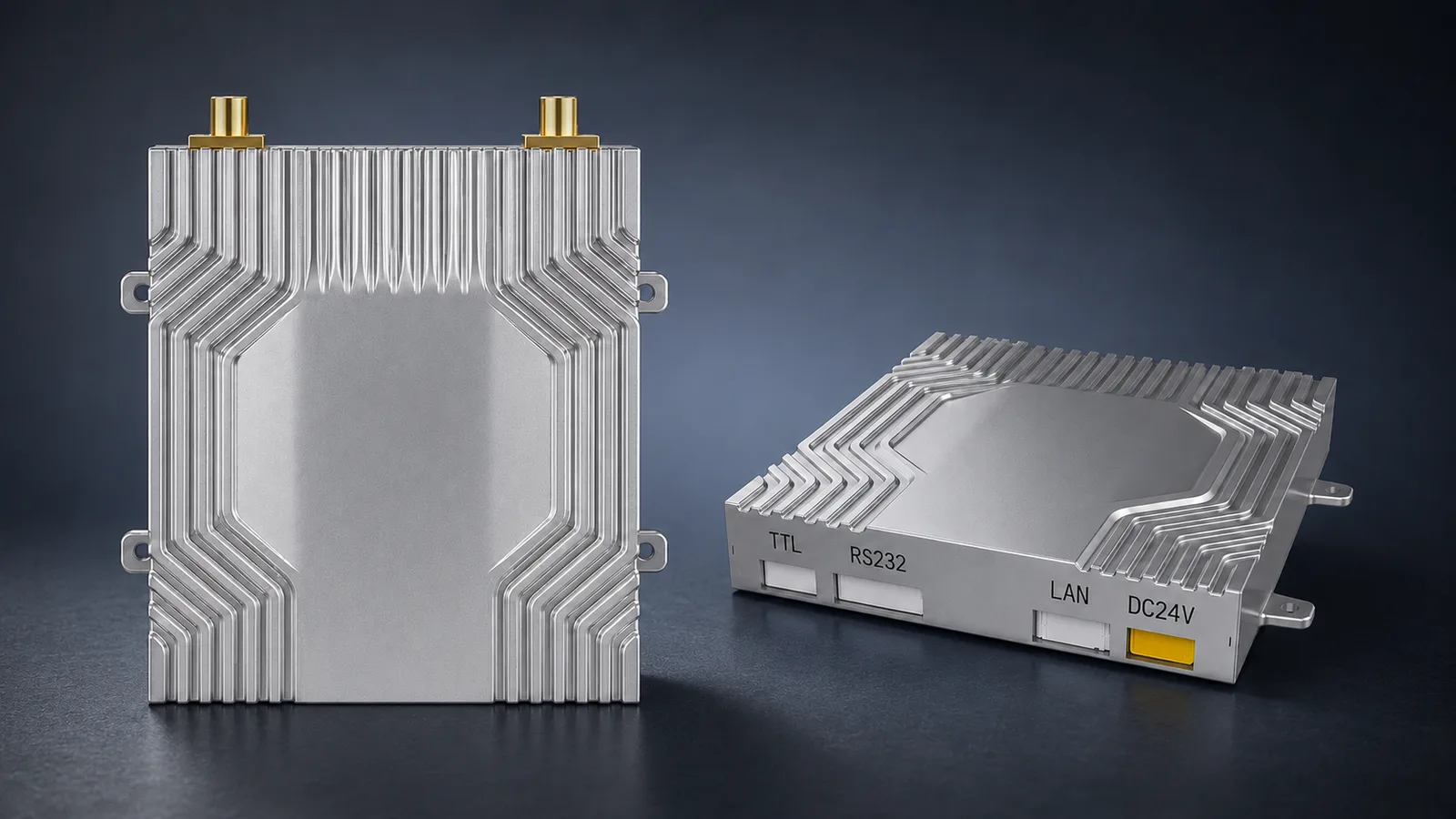
Actual communication performance may vary depending on antenna installation, terrain, interference, power supply, node placement and local radio regulations. Customers should confirm frequency use and operating requirements according to the laws and standards of their target market.
Why Mesh Networking Matters
One important feature of DL M2 (010) is its support for self-forming network structures. The product manual describes typical applications such as:
- One ground node connected with multiple airborne nodes
- One ground node connected through an airborne relay to multiple airborne nodes
This matters because FPV and UAV platforms are no longer always single-aircraft systems. In development, testing, inspection, mapping, robotics and OEM integration, customers may need multiple mobile nodes to share data across a wider operating area.
Mesh and relay-capable networking can help improve system flexibility, especially when a direct link is not always ideal. For builders, this creates new requirements around installation space, antenna position, power supply and interface planning.
Data Links Need the Right Hardware Around Them
A data-link module cannot work well if the surrounding hardware is poorly planned.
The flight controller needs usable interfaces for receiver, telemetry and external devices. The PDB must provide stable power. The ESC and wiring layout should reduce electrical noise and leave enough physical space for communication hardware and antennas.
This is why JetLancer AI treats DL M2 as part of a wider FPV flight-stack direction, not as an isolated product. AI FC, standard flight controllers, ESCs, PDBs and DL M2 all serve the same practical goal: helping customers build cleaner, more reliable and more connected FPV platforms.
A Practical Step for FPV and OEM Integration
The current FPV ecosystem is moving towards smarter, more connected and more configurable flight stacks. Betaflight’s recent focus on telemetry and MAVLink-related workflows, together with wider BVLOS and ground-control discussions in the drone industry, shows that communication planning is becoming more important.
For JetLancer AI customers, the practical question is not whether every build needs every advanced feature. The real question is whether the hardware leaves enough room for future control, telemetry, data transmission and integration needs.
JetLancer AI now supports FPV builders, UAV developers, system integrators and OEM partners with AI FC, standard flight controllers, ESCs, PDBs and DL M2 data-link hardware.
Contact JetLancer AI to discuss DL M2 data-link integration, AI FC selection, flight controller interfaces, ESC and PDB matching, and OEM FPV hardware requirements.
Interested in AI FC Integration?
Contact us for OEM pricing and technical documentation.
Get in Touch